
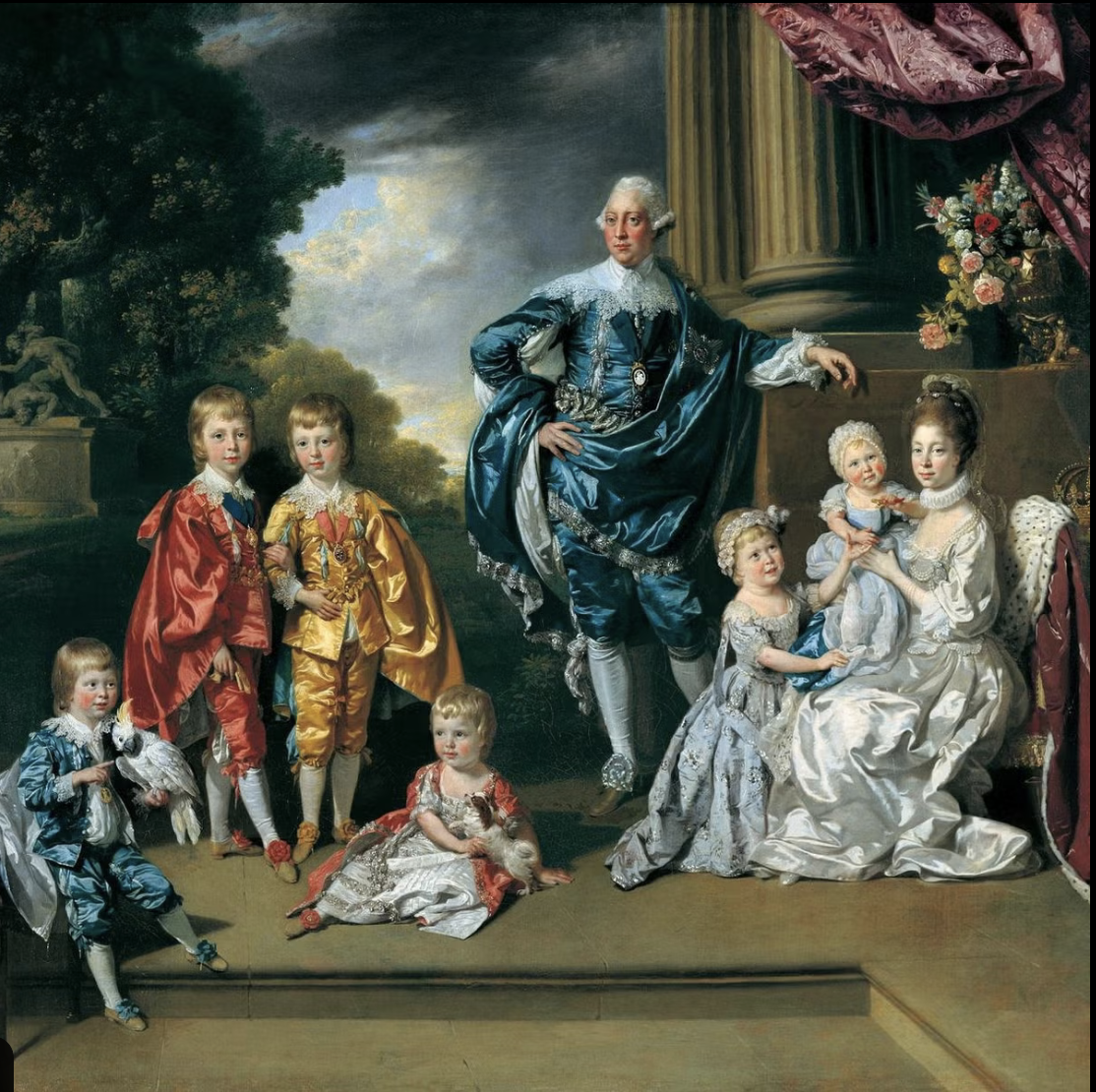
n 1761, seventeen-year-old Charlotte of Mecklenburg-Strelitz arrived in England to marry a king she had never met. She had crossed countries, languages, and expectations to wed George III, twenty-two years old, burdened with a crown and the weight of an empire.
They met for the first time on their wedding day.
By every rule of royal history, this should have been a distant, political arrangement. Instead, it became something rare. Something quietly radical.
George III never took a mistress—almost unheard of for an 18th-century monarch. From the beginning, he was devoted to Charlotte, relying on her not just as his queen, but as his closest companion. She was his confidante, his calm, his emotional refuge in a role that demanded constant authority.
Together, they built a life that defied the excess and scandal of the royal court. They raised fifteen children, filling Windsor with music, education, and family life rather than spectacle. Charlotte was highly intelligent and deeply cultured, an accomplished musician and a patron of the arts. Court life under her influence became restrained, domestic, and unusually centered on marriage and family.
But love did not shield them from tragedy.
By the late 1780s, King George III’s mental health began to deteriorate. What history once called “madness” slowly consumed his clarity, his independence, and eventually his ability to rule. As his illness progressed, Charlotte’s role shifted. She became his protector and his witness, navigating the painful balance between duty to the crown and devotion to the man she loved.
For nearly six decades, she stayed bound to him by loyalty and responsibility—even as illness forced separation for safety and governance. Her life became one of endurance rather than ceremony.
After fifty-seven years of marriage, Charlotte died in 1818 at the age of seventy-four. George followed two years later, in 1820, at eighty-one. Those close to him recorded that even in his final years—blind, isolated, and mentally diminished—he still murmured her name.
History often reduces royal women to marriages and heirs. But Charlotte of Mecklenburg-Strelitz was not a footnote beside a king. She was a constant. A stabilizing force. A woman who entered a marriage with no promises and remained through love, decline, and loss.
Not every powerful woman ruled through command.
Some ruled by staying.