
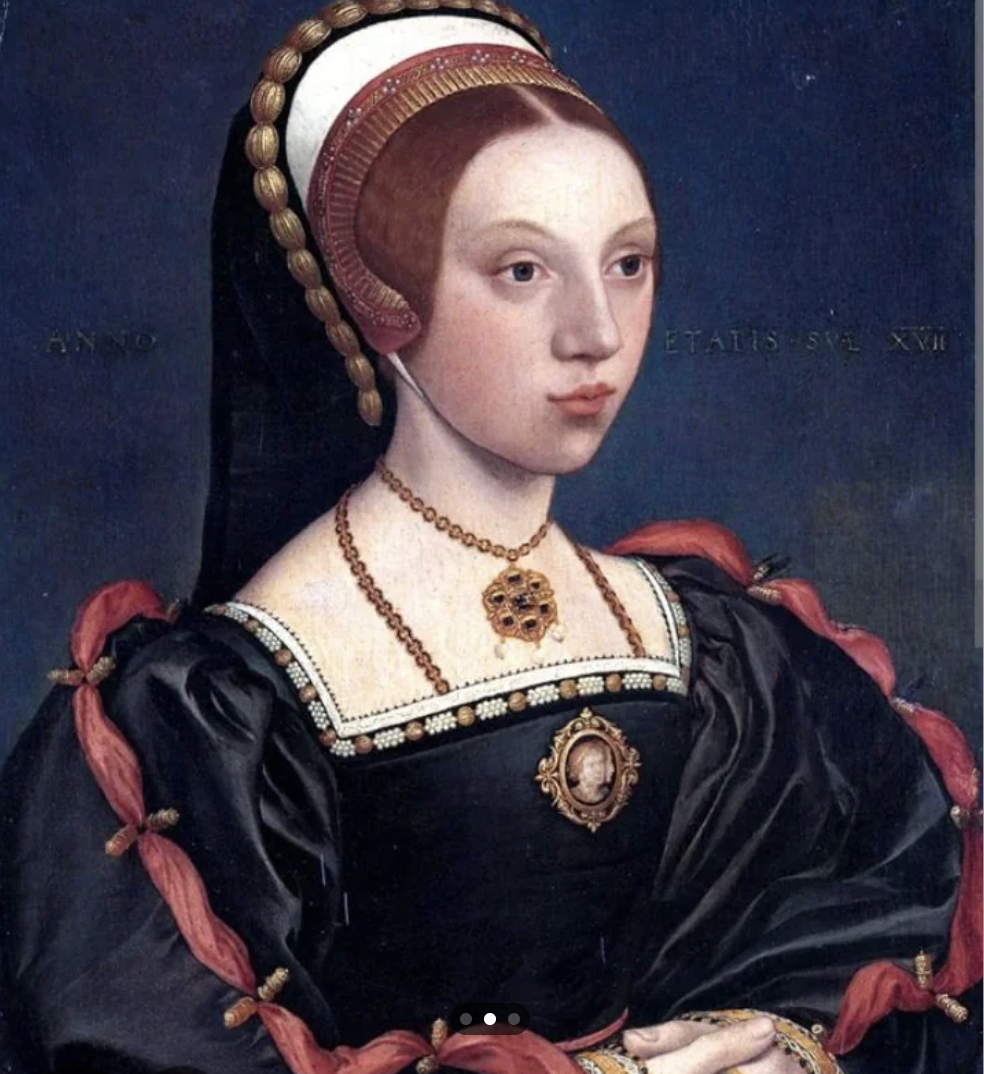
Catherine Howard became Queen of England barely out of girlhood.
Less than two years later, she was dead—executed for treason while still a teenager.
Born into the powerful Howard family and cousin to Anne Boleyn, Catherine should have been protected by rank, name, and blood.
She wasn’t.
As a child, Catherine was sent to live in the household of her step-grandmother, the Dowager Duchess of Norfolk. It was a noble household, but not a carefully guarded one. Supervision was loose. Boundaries were weak. And Catherine grew up in an environment that left a very young girl exposed to men who held more age, power, and experience than she did.
As a young teenager, she became involved with older men.
Modern historians do not view those relationships as youthful romance. They see what the Tudor court refused to see: exploitation. But years later, when Catherine stood at the center of royal power, those experiences would not be treated as evidence of her vulnerability.
They would be used as evidence against her.
By the time she arrived at court as a lady-in-waiting, Catherine was young, attractive, and close enough to be noticed by the king. Henry VIII was nearly fifty—aging, increasingly ill, and far removed from the athletic prince he had once been.
Catherine was everything he was not.
She was lively, flirtatious, and young enough to make him feel renewed. In 1540, Henry married her and made her queen.
But Catherine was not prepared for the court she had entered.
She had not been trained to survive its politics. She lacked the caution, education, and hardened instincts that royal survival required. Instead, she surrounded herself with familiar faces from her past—people she trusted because they belonged to the world she had known before the crown.
That decision destroyed her.
One of those connections exposed her earlier history to the king’s advisers. What had once been private, murky, and rooted in Catherine’s youth was transformed into a political weapon. Investigators pulled apart her past, examining old relationships and new suspicions with ruthless precision.
Henry’s reaction was final.
He never spoke to her again.
The court moved quickly. Francis Dereham and Thomas Culpeper were accused and executed. The people who revealed Catherine’s secrets were not punished. In Tudor England, survival often belonged not to the innocent, but to the useful.
Catherine was left to face the end alone.
In 1542, she was executed at Tower Green.
She was still a teenager.
History often remembers Catherine Howard as reckless, foolish, or fatally naive. But behind that story is something colder: a girl raised without protection, drawn into adult worlds too early, elevated to a throne she was never prepared to survive, and then destroyed by the very court that had made her queen.
A child left vulnerable.
A young queen watched closely.
A teenager sent to the scaffold.