
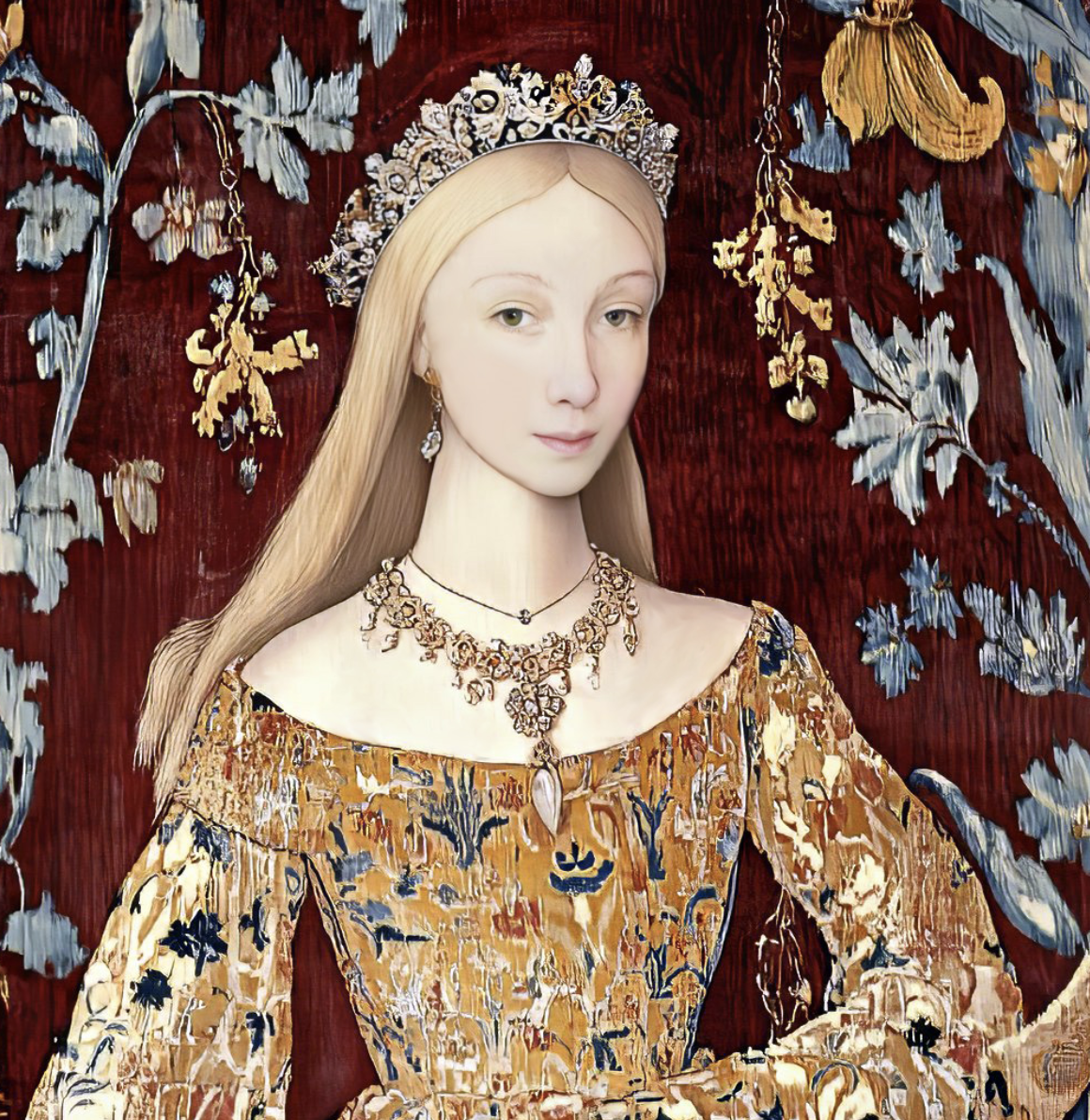
Blanche of Lancaster was born in 1342, the sole heiress of one of the richest families in England.
In a world where women were rarely allowed visible political power, Blanche’s inheritance was power.
She inherited land, titles, and wealth on a scale vast enough to shift the balance of a kingdom. Her value was never only personal. It was dynastic. Whoever married Blanche would gain access to one of the greatest fortunes in medieval England.
That man was John of Gaunt, the third son of King Edward III.
When Blanche married him, the immense Lancaster inheritance passed through her. Through Blanche, John became the richest man in England. Through Blanche, the House of Lancaster rose into a force powerful enough not only to influence the crown—but one day to claim it.
She was not a queen.
But the monarchy England would later fight over was built, in part, on what came through her.
Blanche gave birth to seven children. Only three survived.
And each of those surviving children carried her legacy outward in a different direction.
Her son, Henry Bolingbroke, would go on to overthrow his cousin Richard II and seize the throne as Henry IV. With him began the Lancastrian royal line, a dynasty whose claim to power would later collide violently with the House of York in the Wars of the Roses.
Through one child, Blanche became the mother of kings.
Her daughter Philippa of Lancaster married into the Portuguese royal family, helping strengthen the long alliance between England and Portugal. She became the mother of Portugal’s so-called “Illustrious Generation,” including Henry the Navigator, whose life would help shape the age of exploration.
Through another child, Blanche’s bloodline extended beyond England and into the future of Europe itself.
Her other surviving daughter, Elizabeth of Lancaster, was married repeatedly to secure alliances during years of instability and political unrest. Through Elizabeth, Lancaster blood spread deep into the English nobility, binding Blanche’s lineage even more tightly into the kingdom’s ruling class.
Blanche herself did not live long enough to see the full reach of what began with her.
She died in 1368, only 26 years old, likely during a plague outbreak. Her death devastated John of Gaunt, who openly mourned her and commissioned an elaborate tomb in her memory.
History often remembers the men who wielded the power her inheritance created.
But Blanche of Lancaster was the source.
A woman whose lands made a prince rich.
Whose son became a king.
Whose bloodline helped shape England’s wars, Portugal’s future, and the fate of a dynasty.