
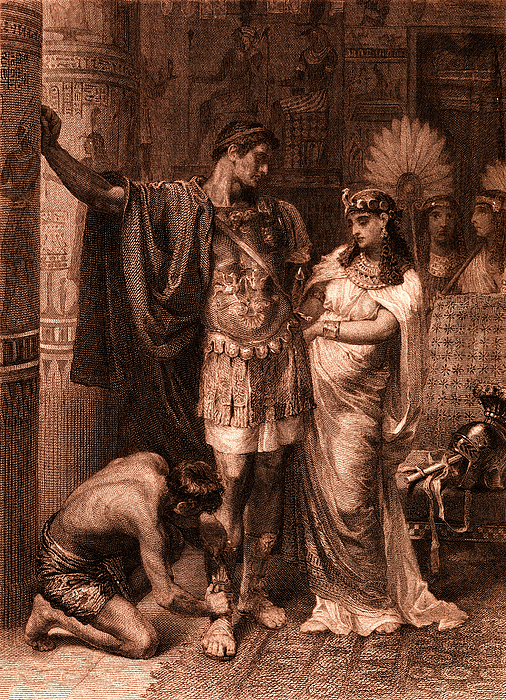
In 41 BCE, when Mark Antony summoned Cleopatra VII, she didn’t arrive as a subject or a supplicant—she arrived as a queen. Sailing up the Cydnus River on a perfumed barge, dressed in gold and surrounded by attendants, she commanded every gaze before she even stepped ashore. Antony was captivated instantly. And the world would soon understand why.
What began as a political meeting became a partnership the ancient world never forgot. Cleopatra and Antony became lovers and allies, bound not only by desire but by ambition. In their years together, they had three children—Alexander Helios, Cleopatra Selene II, and Ptolemy Philadelphus—symbols of the future they hoped to build between Egypt and Rome.
But love rarely survives the weight of empire.
By 31 BCE, Rome turned against them. Octavian, the future Augustus, framed their union as a threat to Roman virtue and Roman power. The Battle of Actium crushed their forces, and the world Antony and Cleopatra had created began to collapse. Cornered, abandoned, and outmatched, they chose their own fate. Antony died first. Cleopatra followed in 30 BCE, at just thirty-nine years old—ending her life as she had lived it: on her own terms.
But their story didn’t end there.
After their deaths, their children became the silent victims of Rome’s victory. Alexander Helios and Ptolemy Philadelphus were taken to Rome and soon disappeared from the historical record. Most historians believe they died young—quietly removed because their bloodline posed too great a political threat.
Only one child survived to adulthood: Cleopatra Selene II.
Raised in the household of Octavia, the sister of Augustus, she received an elite education and the kind of cultural training her mother would have fiercely approved of. As an adult, she married Juba II and became Queen of Mauretania, carrying her mother’s lineage across the Mediterranean into a new kingdom. Through her, Cleopatra’s bloodline lived on.
Two brothers vanished into Rome’s shadows.
One sister rebuilt a throne from its ruins.
And the love story of Antony and Cleopatra—fierce, political, intoxicating, and doomed—became one of history’s most enduring legends.