
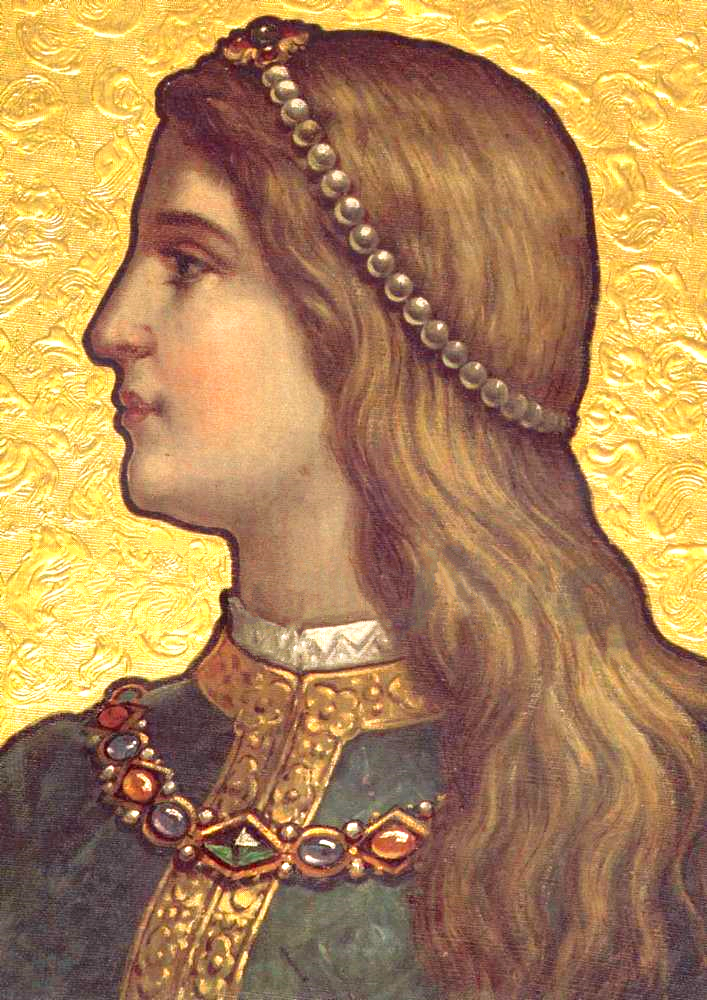
Inês de Castro was never supposed to become one of the most haunting women in Portuguese history.
Born around 1325 into a powerful Galician noble family, she arrived at the Portuguese court as a lady-in-waiting. It was there that she met Pedro of Portugal, the king’s son and heir to the throne.
Pedro was already married.
Inês was not supposed to matter.
But after Pedro’s lawful wife, Constanza of Castile, died, he refused to let Inês disappear. By then, Inês was about twenty years old, and what may once have been dismissed as court scandal became something far more dangerous: public, permanent, and impossible to control.
Pedro and Inês built a life together.
They had four children, and that changed everything. Their relationship was no longer only personal—it was political. Through Inês, Pedro was tied more deeply to Castilian bloodlines, and in 14th-century Portugal, that was enough to provoke fear. The Portuguese court saw not just a woman the prince loved, but a potential threat to the stability of the kingdom.
King Afonso IV of Portugal, Pedro’s father, decided she had to be removed.
At first, Inês was exiled, an attempt to break the relationship without bloodshed. But Pedro defied the order. He brought her back, making it clear that he would not give her up—not for court pressure, not for dynastic caution, not even for the king.
That defiance sealed her fate.
When Inês was about thirty years old, Afonso IV ordered her death without Pedro’s consent. She was seized at the royal estate of Santa Clara-a-Velha in Coimbra, far from the battlefield, far from any formal accusation of treason.
She was condemned for being too dangerous to leave alive.
Contemporary chronicles describe Inês pleading for her life, invoking her children as she faced death. She was killed by royal order while her children were present—old enough to understand what was happening, old enough to remember it.
Pedro was thirty-three when she was murdered.
Two years later, he became King Pedro I of Portugal.
And then he did something history never forgot.
Pedro declared that Inês had been his lawful wife all along. In death, he gave her the title she had never held in life: Queen of Portugal. He ordered her body exhumed and reburied with royal honors, ensuring that the woman his father had tried to erase would instead be remembered forever.
Her children survived her execution.
But survival was not the same as safety.
Though later legitimized by their father, they were never treated as secure members of the royal future. Their mother’s violent death and their connection to Castilian blood made them politically dangerous. None were allowed near the center of power. They were married off, sent away, or quietly kept from the throne their father ruled.
Inês de Castro was not executed for treason.
Not for war.
Not for conspiracy.
She was executed because love, when made public and powerful, became something the crown could not tolerate.
Killed at thirty.
Made queen after death.
And remembered more vividly than many women who wore the crown in life.
You might also like
 Blanche of Lancaster: The Heiress Who Made the House of Lancaster Powerful Enough to Rule England
 Maria of Aragon: The Princess Replaced, Reclaimed, and Quietly Loved
 Mary, Queen of Scots: The Scandals, Escapes, and Tragic Death of Scotland’s Most Famous Queen
 Margaret Beaufort: The Mother Who Created the Tudor Dynasty at Age 13