
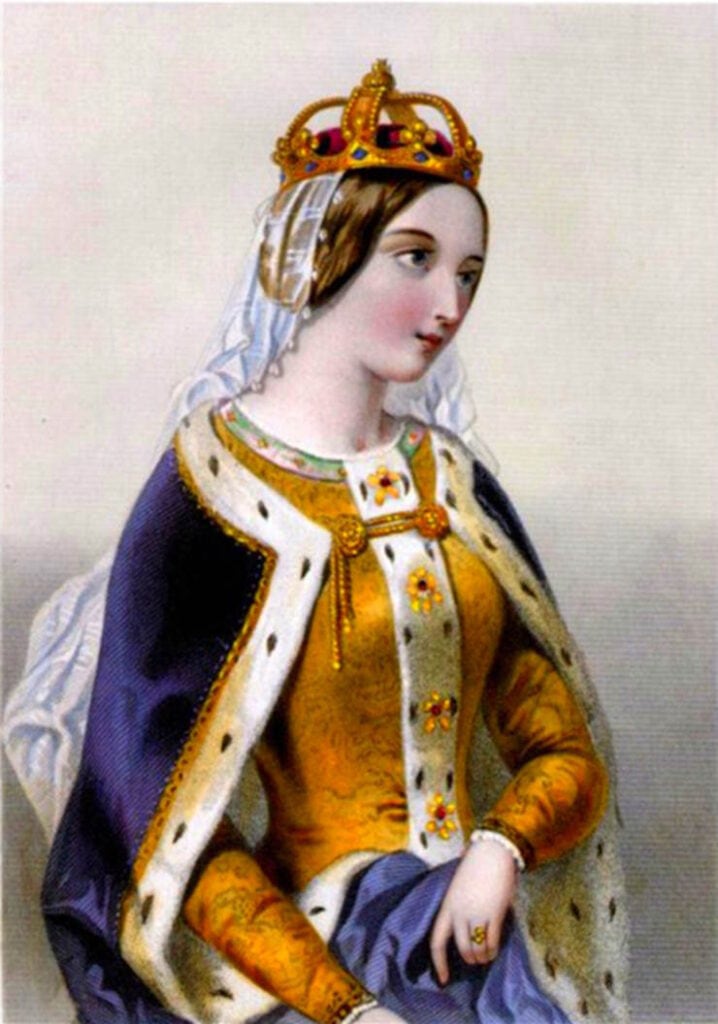
Catherine of Valois was promised in marriage as a child and crowned Queen of England at just 19 years old.
Her marriage to Henry V was never meant to be a love story. It was political from the beginning—a union forged through diplomacy after war, sealed by the Treaty of Troyes and designed to bind England and France through conquest, not affection.
For a brief moment, Catherine stood at the center of triumph.
Then everything changed.
By 21, she was a widow.
Henry V was dead. Their son, the future Henry VI, was still an infant—not yet one year old. Catherine was young, royal, and politically dangerous. As the mother of the king, she carried influence that powerful men did not want left unchecked.
So Parliament moved to control her future.
Laws were shaped to prevent her from remarrying without royal consent. Any man who pursued her risked punishment, imprisonment, and the destruction of his status. Catherine’s body, her future, and even the possibility of love were treated as matters of state.
But Catherine married anyway.
Quietly, and in secret, she formed a relationship with Owen Tudor, a Welshman of far lower rank than the men history usually allows queens to choose. Their marriage sat outside the world of grand diplomacy and royal approval, and for that reason it has often been pushed to the edges of the story.
But it changed England forever.
Among their children was Edmund Tudor.
Edmund would go on to marry Margaret Beaufort, a girl descended from the House of Lancaster. She was only thirteen years old when she gave birth to their son. The labor nearly killed her, and it left such lasting damage that she would never bear another child.
That child was Henry Tudor.
For years, his survival was uncertain. During the chaos of the Wars of the Roses, Henry lived in exile while rival dynasties fought for the English crown. His mother, Margaret Beaufort, spent decades protecting his claim—building alliances, navigating danger, and waiting for the moment when the balance of power might finally shift.
In 1485, it did.
Henry defeated Richard III at the Battle of Bosworth, took the throne as Henry VII, and founded the Tudor dynasty.
The dynasty that would produce Henry VIII, Mary I, and Elizabeth I began not with a king’s grand strategy, but with a widowed queen who married where power told her not to.
Catherine of Valois is often remembered only as Henry V’s widow.
But her second marriage—private, dangerous, and politically forbidden—reshaped the English monarchy.
You might also like
 Married at 6 to a 29-Year-Old King: The Tragic Life of Isabella of Valois
 Elizabeth “Bessie” Blount: The Mistress Who Gave Henry VIII His Only Acknowledged Illegitimate Son
 Margaret Beaufort: The Mother Who Created the Tudor Dynasty at Age 13
 Catherine Howard: The Teen Queen Henry VIII Sent to the Scaffold