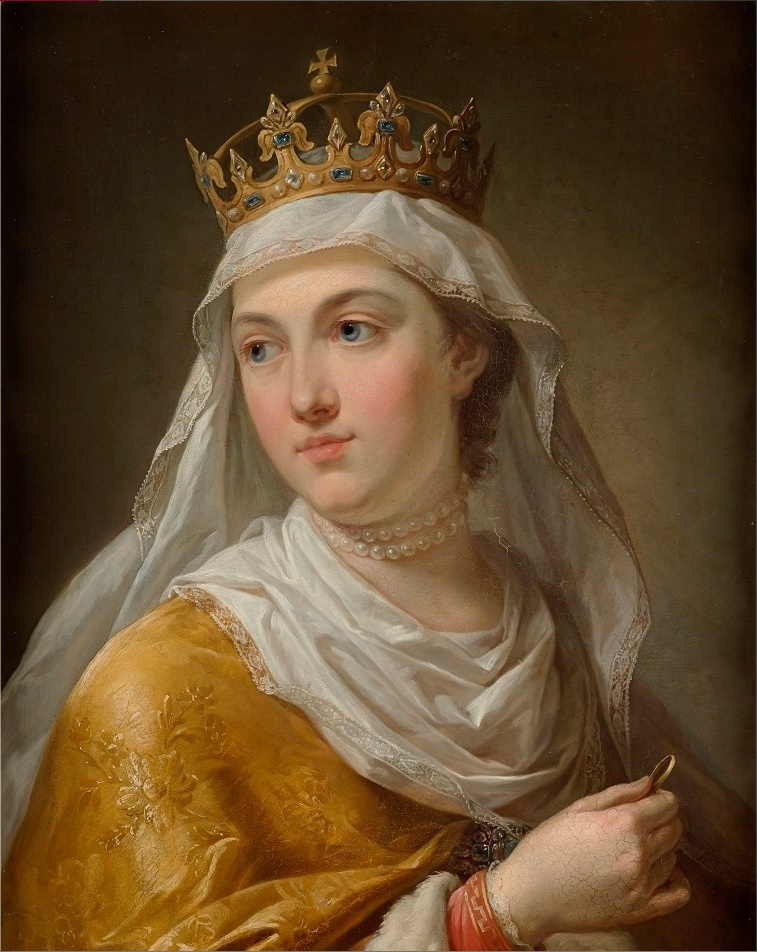
Hedwig of Anjou was betrothed at about four years old.
Her future was decided before she could even write her name.
Born in 1373, Hedwig was the daughter of Louis I of Hungary and Poland, a king who ruled vast territories in Central Europe. When he died in 1382 without a surviving son, the question of succession became urgent.
Poland chose Hedwig.
She was brought to Kraków as a child and placed on the throne of a kingdom that needed stability. In 1384, when Hedwig was only ten years old, she was crowned with a title rarely given to a woman.
Not queen.
King of Poland.
The wording was deliberate. By crowning her king, the Polish nobility made it clear that Hedwig ruled in her own right, not simply as the future wife of a male monarch. Her authority came from the crown itself.
But politics quickly demanded another decision.
At around twelve or thirteen, Hedwig married Jogaila, Grand Duke of Lithuania, a union that would change the course of European history. As part of the agreement, Jogaila converted to Christianity, was baptized as Władysław II Jagiełło, and became king alongside Hedwig.
The marriage was not simply dynastic.
It led to the Christianization of Lithuania, one of the last pagan regions in Europe, and laid the foundation for what would become the Polish-Lithuanian state—one of the largest and most influential political powers in medieval Europe.
Despite her youth, Hedwig took her role seriously.
Contemporary accounts describe her as deeply educated, politically thoughtful, and committed to governance. She mediated disputes between nobles, supported the church and religious institutions, and became a patron of learning. Her influence also helped strengthen the future Jagiellonian dynasty, which would rule parts of Central and Eastern Europe for generations.
But her life was short.
In 1399, Hedwig gave birth to her first child, a daughter. The baby died soon after birth.
Only weeks later, Hedwig herself died from complications related to childbirth.
She was twenty-five years old.
In just fifteen years on the throne, the child who had been crowned king reshaped alliances, altered the religious map of Europe, and helped create a dynasty that would dominate the region for centuries.
A ruler before adulthood.
A king before twenty.
And gone before history could fully see what she might have become.
You might also like
 Maria Theresa of Austria: The Empress Who Ruled Europe While Pregnant Sixteen Times
 Empress Matilda: The Woman Who Almost Became England’s First Queen
 Married at 6 to a 29-Year-Old King: The Tragic Life of Isabella of Valois
 Blanche of Lancaster: The Heiress Who Made the House of Lancaster Powerful Enough to Rule England