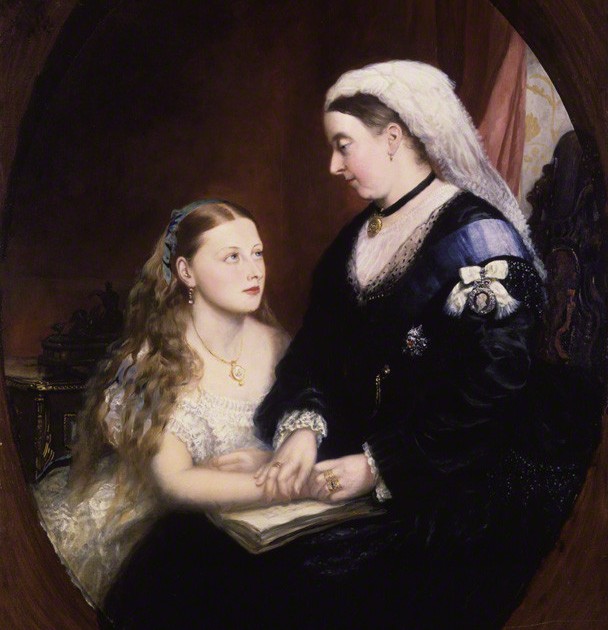
Among Queen Victoria’s nine children, two of the youngest shared a bond shaped by circumstance, illness, and quiet devotion.
Princess Beatrice and Prince Leopold grew up in the shadow of a monarchy defined by duty and expectation. But within the vast royal household, their relationship was deeply personal. They were not only siblings—they were companions.
Prince Leopold’s life had been fragile from the beginning.
He was born with hemophilia, a genetic disorder that prevents blood from clotting normally. In the 19th century, long before modern treatments, the condition made even small injuries potentially fatal. A fall, a cut, or internal bleeding could quickly become life-threatening.
Because of this, Leopold’s childhood was carefully controlled.
His activities were monitored, risks were avoided, and independence was limited in ways his siblings rarely experienced. Isolation was often unavoidable. While other royal children traveled, socialized, and pursued the freedoms of aristocratic life, Leopold’s world was shaped by constant caution.
Princess Beatrice stayed close.
The youngest daughter of Queen Victoria, she developed a quiet role as Leopold’s companion and protector. Where others moved through court life, Beatrice often remained near her brother, sharing in the slower, more cautious rhythm his condition demanded.
Their closeness grew from necessity, but it also became something deeper—a steady presence in a life defined by uncertainty.
In 1882, Leopold took a step toward independence.
He married Princess Helena of Waldeck and Pyrmont, hoping to build a life beyond the strict boundaries that had long surrounded him. For a brief time, it seemed possible that he might finally live with more freedom.
But the danger that had always followed him never disappeared.
In 1884, while in Cannes, Leopold slipped and fell. The injury might have been minor for most people, but for someone with hemophilia, it was catastrophic. Internal bleeding led to complications that doctors could not stop.
He died soon after.
Prince Leopold was just 30 years old.
His death carried another quiet tragedy. His wife was pregnant at the time. Their son, Prince Charles Edward, was born after Leopold’s death—growing up never having met the father whose life had been so carefully guarded.
For Princess Beatrice, the loss changed everything.
Leopold had been one of the few people who shared her place in the royal family’s most intimate circle. Without him, her world narrowed even further. Beatrice eventually married Prince Henry of Battenberg, but her life never truly moved away from her mother.
Queen Victoria relied on her youngest daughter more than ever.
Beatrice became her constant companion, secretary, and confidante, remaining by the queen’s side for decades. Independence—something Leopold had briefly tried to claim—was never fully hers.
Two siblings who had grown up closely bound by circumstance ended their lives very differently.
One had fought for freedom but lost it to illness.
The other lived on, quietly carrying the weight of duty in the space he left behind.