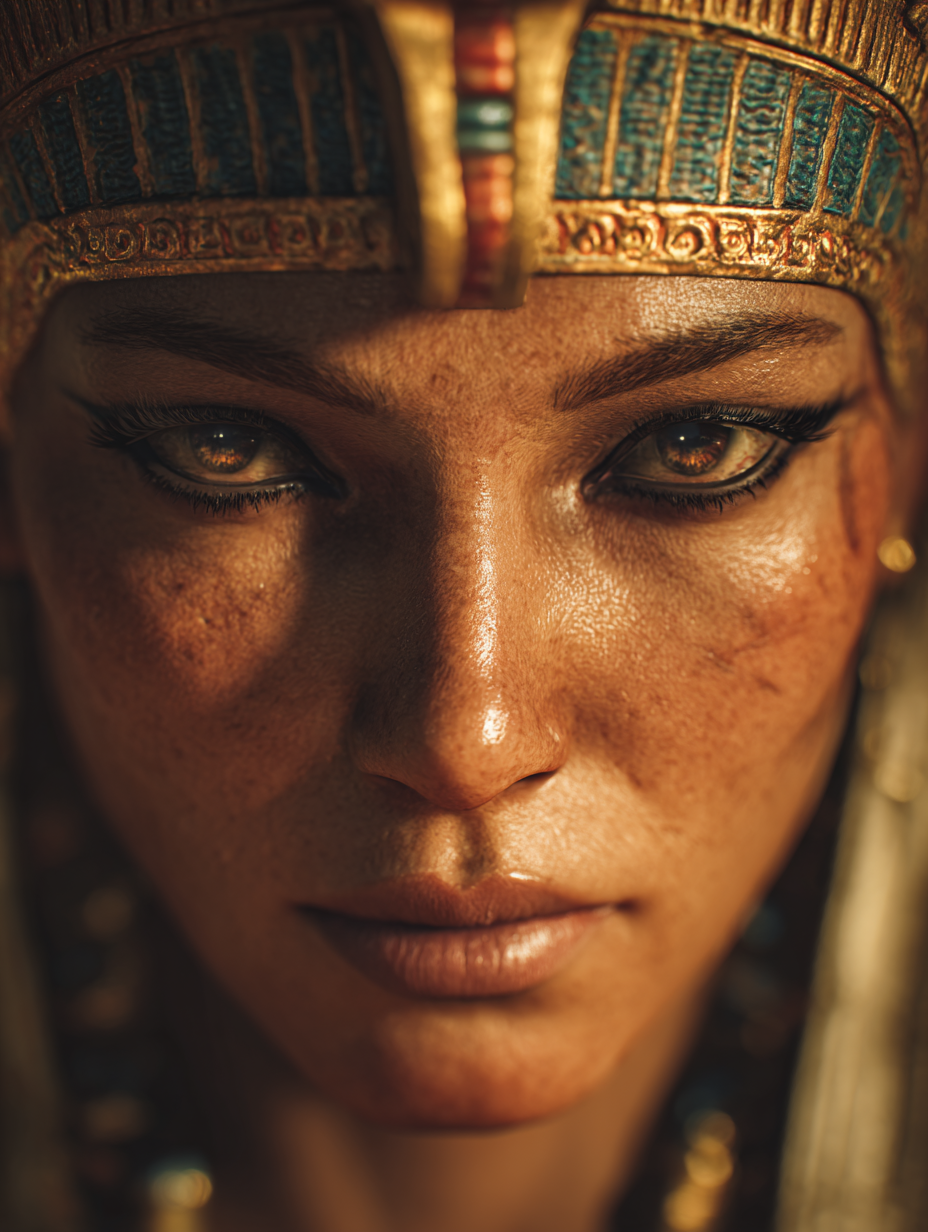
When Hatshepsut became Pharaoh around 1479 BCE, she was about thirty years old—living in a world where kingship was reserved for men. But she didn’t wait for permission or acceptance. She simply claimed the throne herself. She placed the royal crown on her head, took on the full regalia of a king—including the ceremonial false beard—and stepped into power with a confidence that defied every expectation of Ancient Egypt.
Her reign didn’t just function—it flourished. For more than two decades, Egypt enjoyed peace, stability, and prosperity under her rule. Trade expeditions reached the Land of Punt. Temples rose in her honor. Her mortuary temple at Deir el-Bahri remains one of the most breathtaking achievements of the ancient world. She ruled not as a placeholder, not as a regent, but as a true Pharaoh—deeply aware of her authority and unafraid to wield it.
And yet, when she died around age fifty, the men who followed her tried everything to make her disappear. Her statues were smashed. Her name was chiseled off walls. Her images defaced. It was a political erasure—an attempt to rewrite history by pretending a woman had never worn the double crown.
But stone has a long memory.
Even in fragments, Hatshepsut’s legacy survived. The temples she built still tower above the desert. The obelisks she raised still catch the sun. And today, thousands of years after her enemies tried to silence her, she stands as one of the most powerful women ever to rule.
A queen who refused to stay a queen.
A woman who made herself Pharaoh.
A legacy no chisel could erase.