
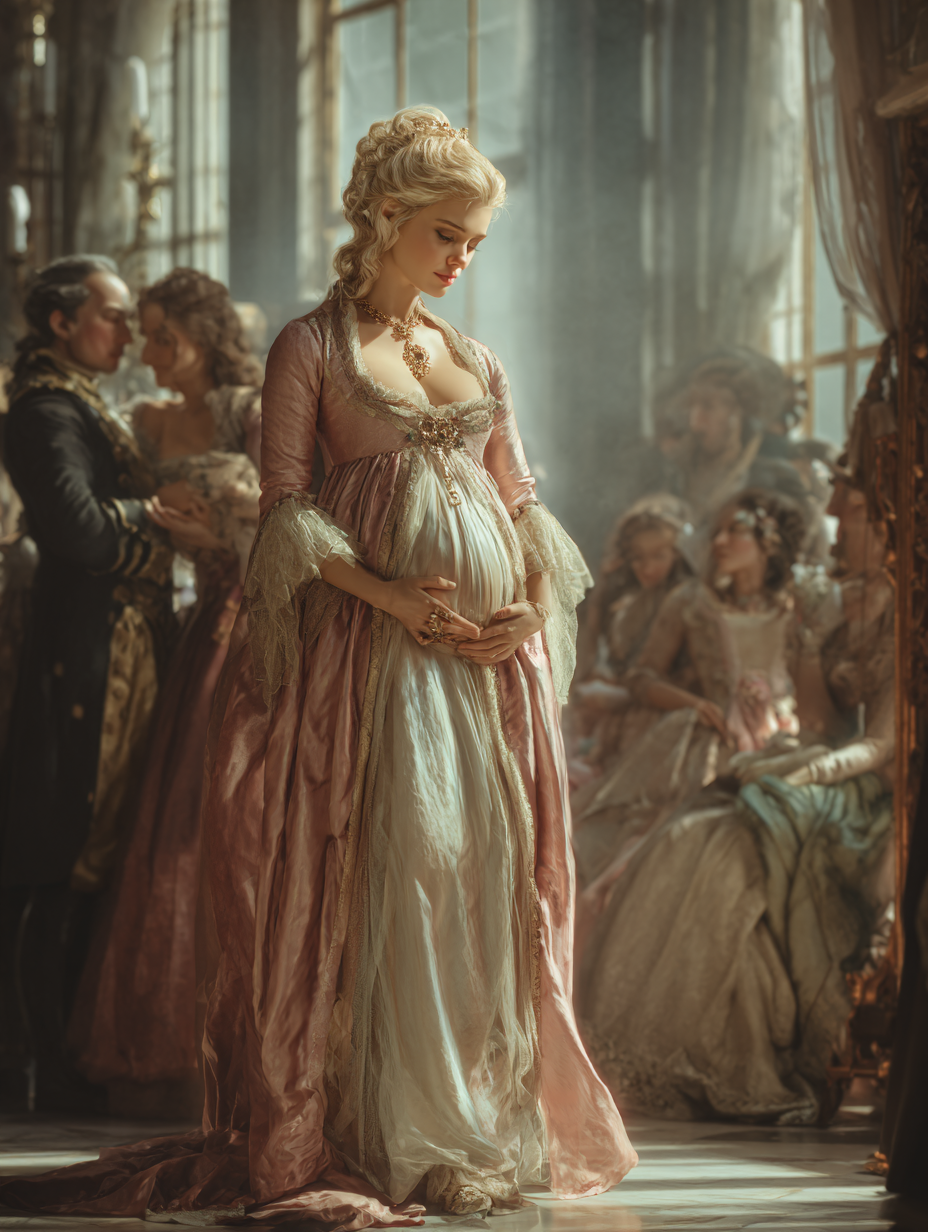
For Marie Antoinette, childbirth was not a private moment of vulnerability—it was a public performance.
When she went into labor with her first child in 1778, the Queen of France was subjected to one of the most invasive traditions of royal life. Nearly 200 courtiers, nobles, and officials were allowed into her bedchamber to witness the birth. The reason was brutally simple: the royal court feared deception. They believed a baby could be secretly swapped, altered, or falsified if the queen labored in private.
So they watched.
The room grew unbearably hot. Bodies pressed in. Windows were sealed. Fresh air disappeared. Marie Antoinette—young, frightened, and in pain—began to lose consciousness as the crowd surged closer, desperate for proof of a legitimate heir.
At one point, she nearly collapsed.
Only when her condition became visibly dangerous were attendants finally forced to push people back and open windows. The baby—a daughter, Marie-Thérèse—survived. So did the queen. But the damage was done.
This was not just a difficult birth.
It was a traumatic spectacle.
Marie Antoinette later described the experience as terrifying and overwhelming. She had been raised in relative emotional warmth in Austria; Versailles offered none of that. Her body was treated as state property. Her suffering was considered irrelevant compared to the political need for certainty.
The event shocked even some members of the court. Slowly, attitudes began to shift. By the time of later royal births, restrictions were introduced. Fewer witnesses. More concern for the mother’s health. A quiet acknowledgment that tradition had crossed a human line.
Her ordeal helped change royal childbirth protocols forever.
History often reduces Marie Antoinette to gowns, excess, and downfall. But moments like this reveal something deeper: a teenage queen stripped of privacy, dignity, and bodily autonomy—enduring pain not just to produce an heir, but to reassure a system that never trusted her.
She was not weak.
She was watched, pressured, and pushed to the brink—and survived.
You might also like
 Marie Antoinette and Louis XVI: The Royal Marriage That Ended in Revolution
 Princess Charlotte of Wales: The Royal Birth That Ended in Tragedy
 Marie Antoinette & Princesse de Lamballe: A Friendship That Survived a Revolution
 Marie Antoinette and Madame du Barry: The Silent Feud That Ended at the Guillotine